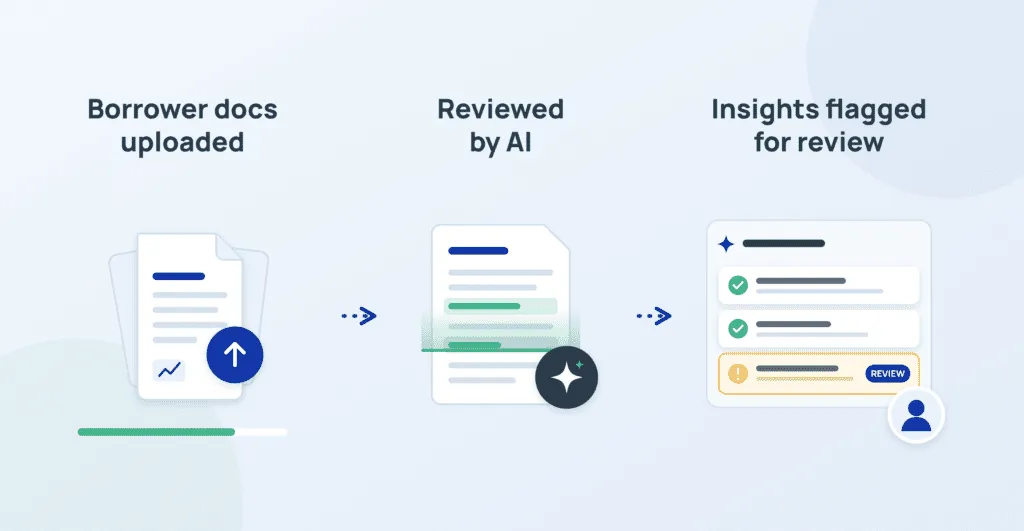
An AI loan origination system is software that uses artificial intelligence to automate repetitive steps in the lending process (document intake, data extraction, compliance checks, risk scoring) while keeping final credit decisions in the hands of human underwriters. For private lenders who fund hard money, bridge, and debt service coverage ratio (DSCR) loans, this technology addresses a persistent tension: how to process more deals faster without surrendering the relationship-driven judgment that sets private lending apart from institutional channels.
What is an AI loan origination system?
A loan origination system, or LOS, is the centralized software platform where lenders process applications from intake through closing. A traditional LOS digitizes forms, tracks pipeline status, and stores documents, but still relies on staff to manually review files, chase missing paperwork, and verify data across systems.
An AI loan origination system layers machine learning, natural language processing, and intelligent automation on top of that foundation. Instead of simply storing a borrower’s tax return, for example, an AI-powered LOS can extract key figures, cross-reference them against the application, and flag discrepancies, all before a human touches it.
Unlike banks originating conforming mortgages against standardized guidelines, private lending shops evaluate deals on asset value, borrower experience, exit strategy, and dozens of deal-specific variables. An AI loan origination system built for this market doesn’t replace that nuanced analysis. It takes on the manual busywork surrounding it so underwriters can focus on the judgment calls that actually require expertise.
The Mortgage Office recently introduced TMO Envoy, an AI-native intelligent loan origination system designed specifically for private lenders. It is an example of the technology being purpose-built for non-institutional workflows rather than retrofitted from conventional mortgage platforms.
How an AI loan origination system works from application to funding
Every platform differs in specifics, but most follow the same general sequence from first contact to funded deal.
Application intake and data extraction
When a borrower or broker submits an application (through an online portal, email, or uploaded document package), AI handles the initial triage. Optical character recognition (OCR) and natural language processing extract data from bank statements, appraisals, entity documents, and personal financial statements. The system populates loan fields automatically, flags incomplete submissions, and sends targeted requests for missing items rather than generic stipulation lists.
Automated underwriting triage
Once the data is structured, AI models score the deal against your lending criteria. That might mean evaluating a bridge loan’s as-is value, rehab budget, and after-repair value (ARV) against your maximum loan-to-value (LTV) thresholds. On a DSCR loan, the system calculates the debt service coverage ratio from extracted rent rolls and compares it to your minimum requirements. Deals that clearly meet guidelines can easily move forward. Borderline files get flagged for manual review with a summary of the specific risk factors that triggered the flag.
Compliance and document generation
Regulatory checks such as state licensing verification, disclosures, and usury limits run in parallel rather than as a sequential bottleneck. Through integrations with document preparation partners like Doss Docs, the system can quickly generate closing packages once a loan is approved, reducing the days-long gap between approval and doc-out that slows manual workflows.
Closing and funding
With documents generated, the system coordinates closing conditions, tracks wire instructions, and updates the loan status across your pipeline in real time. Post-funding, the loan can transition directly into servicing or, in the case of construction and fix-and-flip deals, into draw management workflows that track disbursements against completed work.
What AI automates and what underwriting decisions stay with people
A common concern private lenders raise about AI is whether it will make credit decisions for them. It won’t, if the system is designed correctly.
A well-designed AI loan origination system speeds up the process without overriding human judgment.
Most systems split the work between AI and human staff along these lines:
| AI handles | Humans decide |
|---|---|
| Document intake and data extraction | Final credit approval or denial |
| Automated compliance and disclosure checks | Exception handling for non-standard deals |
| DSCR, LTV, and debt-yield calculations | Borrower relationship and experience evaluation |
| Pipeline prioritization and task routing | Exit strategy feasibility |
| Duplicate and fraud detection | Loan structuring and pricing |
| Status notifications to borrowers and brokers | Portfolio concentration and risk appetite |
The key principle is that AI processes information, and people make judgments. When a borrower’s entity structure is unusual, when the exit strategy depends on a rezoning application, or when the deal requires a creative structure to work, those decisions stay with your team. AI simply ensures your team isn’t spending hours on data entry and document chasing before they get to the actual underwriting.
AI loan origination for hard money, bridge loan, and DSCR loan workflows
The value an AI loan origination system delivers varies by loan product, and well-designed platforms adapt their automation to the specific workflow each product demands.
Hard money loans
Hard money deals are asset-driven and time-sensitive. Borrowers often need funding in days, not weeks. AI accelerates these transactions by automatically extracting property data from appraisals and broker price opinions (BPOs), calculating LTV against your guidelines, and generating preliminary term sheets before an underwriter reviews the file.
Bridge loans
Bridge loans involve transitional properties, value-add business plans, and exit strategies that require nuanced evaluation. AI adds value in the data-gathering phase by pulling comparable sales, analyzing rent comps, and calculating projected stabilized value, while leaving the feasibility assessment to experienced underwriters. Automated draw management tracking becomes especially important post-funding, as construction and renovation milestones trigger disbursements that need to be verified against the approved budget.
DSCR loans
DSCR loans on investment properties are among the most automatable private lending products. The underwriting is formulaic: extract rental income from a lease or rent roll, calculate operating expenses, divide net operating income by the debt service, and compare the ratio to your threshold. AI handles this math quickly and consistently across hundreds of files. Human judgment comes in when evaluating market-level rent sustainability, tenant quality, and whether the borrower’s portfolio concentration introduces risk the ratio alone doesn’t capture.
SBA and other loan types
AI loan origination systems can also support Small Business Administration (SBA) loan workflows and other structured products. The same principles apply, with automation for the data-intensive, rules-based steps and human oversight for judgment calls.
Benefits of an AI loan origination system: faster cycle times, higher throughput, and easier compliance
Faster cycle times
Manual origination is slow because every step waits on a person. AI collapses the sequential bottleneck by running intake, data extraction, compliance checks, and calculations in parallel. Industry benchmarks put the cycle-time reduction at up to 30 percent, which turns a 14-day process into a 10-day process, or a 7-day hard money close into a 5-day close. Private lending trends in 2026 point toward increasing borrower expectations for speed.
Higher loans-per-processor throughput
When processors and underwriters spend less time on data entry and document chasing, they can handle more files. As TMO has documented, the right platform should support your growth from 25 to 50,000 loans without requiring you to rebuild your infrastructure at each stage.
Easier compliance
Compliance errors cost money in penalties, plus the time spent on remediation and the reputational damage with investors and warehouse lenders. AI systems apply regulatory rules consistently across every file. This helps reduce the risk of a missed disclosure, state-specific requirement, or usury ceiling. Compliance managers can also pull automated audit trails during examinations instead of keeping manual logs.
How to evaluate an AI loan origination system
Not every AI-powered platform is built for private lending.
Key evaluation criteria
- Private lending specificity. Does the system support non-qualified mortgage (non-QM), asset-based, and business-purpose loans natively, or is it a conventional mortgage platform with bolted-on workarounds?
- Human-in-the-loop design. Does the AI assist your underwriters, or does it attempt to replace them? Look for systems that surface recommendations and flag risks rather than auto-approving or auto-declining.
- Scalability. Will the platform grow with your volume? A system that works at 50 loans per month but breaks down at 500 is a short-term fix.
- Transparent pricing. Understand whether you’re paying per loan, per user, or on a flat subscription. Hidden fees for AI features, application programming interface (API) calls, or storage can inflate costs quickly.
Speed up your loan origination with The Mortgage Office
For 45+ years, TMO has built software purpose-built for private lenders rather than adapted from conventional mortgage platforms or generalized from fintech frameworks. TMO’s AI-powered origination capabilities, including TMO Envoy, are designed to automate the steps that don’t require your judgment and help your team make the calls that do with faster, better-informed data.
Whether you’re funding hard money rehabs, stabilized DSCR rentals, or complex bridge transactions, TMO’s platform scales with your business and keeps you in control of every credit decision.
Explore TMO’s origination and servicing product suite, or schedule a walkthrough to see how AI-powered origination works for private lenders.
Frequently Asked Questions (FAQs)
What is an AI loan origination system?
An AI loan origination system is software that uses artificial intelligence to automate repetitive lending steps, such as document intake, data extraction, compliance checks, and risk scoring. Final credit decisions stay with human underwriters.
Does an AI loan origination system replace underwriters?
No, a well-designed AI loan origination system assists underwriters rather than replacing them. AI handles data extraction, calculations, and task routing, while people keep final credit approval, exception handling, loan structuring, and pricing.
Which private lending loans are easiest to automate with AI?
Debt service coverage ratio (DSCR) loans are among the most automatable because their underwriting is formulaic. AI extracts rental income, calculates the ratio, and compares it to your threshold. Bridge and hard money loans also benefit, mainly in data gathering and LTV calculations.
Does The Mortgage Office offer an AI loan origination system?
Yes, The Mortgage Office introduced TMO Envoy, an AI-native intelligent loan origination system designed specifically for private lenders. The Mortgage Office provides TMO Envoy as part of its origination capabilities for private lenders.