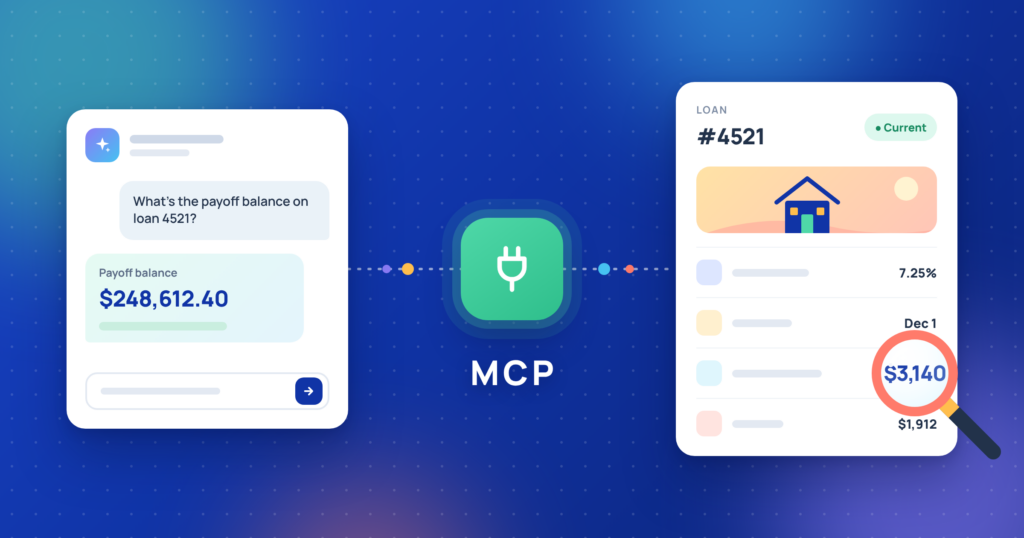
If you manage a portfolio of loans and have wondered whether you can connect your loan servicing software to an AI assistant like ChatGPT or Claude to answer questions about your data, the answer is now yes. The technology making it possible is called Model Context Protocol, or MCP. MCP is an open standard that creates a secure, structured bridge between AI models and external systems like loan management platforms. Instead of forcing you to copy data into spreadsheets or manually look up payment histories, MCP lets an AI assistant query your live loan data directly, with built-in compliance guardrails, audit trails, and permission controls. Private lenders and servicers can automate repetitive borrower inquiries and surface portfolio insights without replacing the software they already rely on.
What is MCP (Model Context Protocol)? A plain-language definition
Model Context Protocol is a standardized way for AI agents to connect to external systems, tools, and data sources. Think of it as a universal translator between an AI assistant and your loan servicing software. Rather than building a custom integration from scratch every time you want AI to access a new data source, MCP provides a common language that any compatible AI model can speak.
Anthropic originally developed and open-sourced the protocol, and it has since gained traction across the financial services industry. MCP is standardized and isn’t a proprietary plugin tied to one vendor. It’s a protocol, much like HTTP (Hypertext Transfer Protocol) is a protocol for the web. Any AI model that supports MCP can connect to any system that exposes an MCP server.
Your portfolio data (payment histories, escrow balances, delinquency statuses, and investor allocations) can become accessible to AI assistants through a governed, structured connection rather than through risky workarounds like pasting data into chat windows.
How MCP connects AI assistants to your loan servicing software through a model API and context layers
Understanding how MCP works doesn’t require a computer science degree. The architecture follows a straightforward client-server pattern:
- MCP server: Your loan servicing software exposes a server that defines what data and actions are available. This is where context layers come in. The server determines which loan fields, reports, and queries the AI can access.
- MCP client: The AI assistant (for example, Claude, ChatGPT, or another compatible model) is the client, sending structured requests through the protocol.
- Model API: The connection between client and server operates through a model application programming interface (API), a defined interface that governs how requests are made, what data is returned, and what format it takes.
When a user asks the AI assistant a question like “What’s the current payoff balance on loan 4521?”, the AI doesn’t guess. It sends a structured context query through MCP to your loan servicing system, retrieves the live data, and returns an accurate answer. The AI never stores your loan data. It accesses it in real time, within the boundaries you define.
This is different from uploading a loan tape to a chatbot. With MCP, the canonical data model stays in your servicing system. The AI reads from it but doesn’t duplicate or own it.
The Mortgage Office recently released AI portfolio tools that put this architecture into practice, so lenders can connect their live loan data to AI assistants through MCP. TMO’s broader Turing release laid the groundwork for this AI connectivity. TMO’s implementation enforces the same permission controls and auditable query behavior described below, and is available directly within the platform.
Security, compliance, and guardrails: keeping loan data protected with MCP
Anyone managing borrower financial data will ask about security before anything else when evaluating an AI integration. MCP addresses this with built-in guardrails that match the way regulated financial institutions already operate.
Data never leaves your system of record
MCP is a read-access protocol by default. The AI assistant queries your loan data in real time but does not extract, copy, or store it. Your servicing platform remains the single source of truth. In TMO’s implementation, MCP enforces this read-only behavior by default.
Authentication and identity verification
Secure MCP implementations layer on enterprise authentication. When paired with single sign-on (SSO), every AI-connected session is tied to a verified identity, creating an audit trail that maps every query to a specific user.
Regulatory alignment
Compliance frameworks like the Gramm-Leach-Bliley Act (GLBA) require financial institutions to protect consumer data and control how it’s shared. AI deployments that bypass these controls create real regulatory exposure. MCP’s architecture (read-only access, scoped permissions, and auditable queries) is designed to operate within these requirements rather than around them.
TMO has also achieved SOC 2 Type II compliance, which independently verifies that the underlying data environment meets rigorous security controls before AI is ever connected.
Can AI agents using MCP change or edit loan data?
In a properly configured MCP implementation, AI agents operate in read-only mode. They can retrieve and summarize data, but they cannot modify loan records, process payments, or alter borrower information. Write access, if ever enabled, would require explicit authorization rules and additional security layers. In most loan servicing use cases, read-only access delivers the vast majority of value (answering questions, generating summaries, and flagging exceptions) without introducing write-access risk.
Real-world use cases: borrower inquiries, delinquency workflows, and investor reporting
MCP has the most immediate impact in the daily work of loan servicing.
Automating repetitive borrower questions
A significant portion of inbound calls and emails to servicing teams are routine: “When is my next payment due?” “What’s my current balance?” “Was my last payment received?” With MCP, an AI assistant can answer these questions on demand by pulling real-time data from your servicing platform. Your team stays in place and gets more time for complex borrower situations that require human judgment.
Streamlining delinquency management
Rather than running manual reports to identify at-risk loans, an AI assistant connected through MCP can surface delinquency trends on demand. Ask it “Which loans are 30+ days past due?” or “Show me loans with missed payments in the last 90 days” and get structured, accurate answers drawn from live data.
Accelerating investor reporting
Servicers managing loans on behalf of investors have a constant reporting obligation. MCP-connected AI can pull portfolio performance data, summarize payment distributions, and flag exceptions, so staff spend fewer hours compiling reports from multiple screens and spreadsheets.
Portfolio-level intelligence
Beyond individual loan queries, MCP enables portfolio-wide analysis. Questions like “What’s my weighted average interest rate across all active loans?” or “How many loans mature in the next 12 months?” become conversational queries rather than custom report builds.
MCP’s value in lending workflows comes from connecting AI to structured financial data in a governed way, so data that already exists becomes readily accessible.
Do you need to replace your loan management system to use MCP?
No. MCP is designed to work alongside your existing loan servicing software, not replace it.
MCP is a bridge that sits between your AI assistant and your servicing platform. Your core system of record and your data stay exactly where they are. MCP simply gives AI a structured, permissioned way to ask questions of that data.
This is especially relevant for private lenders and servicers managing portfolios of 50 to 500 loans who don’t have dedicated IT teams or the appetite for a major system migration. You don’t need to rip out your infrastructure or bring on a team of developers. You need a servicing platform that supports MCP (like TMO, which already does) and an AI assistant that speaks the protocol.
Existing TMO customer stories show lenders gaining new capabilities by building on top of their current platform rather than starting over.
Bring secure AI to your loan portfolio with The Mortgage Office
TMO has built MCP connectivity directly into its platform. Through its recently released AI portfolio tools, lenders can securely connect their live loan data to AI assistants like Claude, with the same permission controls and audit trails they already use.
With MCP through TMO, you can automate borrower inquiries, surface delinquency insights on demand, and stop toggling between screens to answer basic portfolio questions.
Each capability maps to a specific benefit:
| Capability | What it means for you |
|---|---|
| Live loan data access via MCP | AI answers are based on real-time data, not stale exports |
| Read-only by default | No risk of AI modifying loan records |
| SOC 2 Type II certified environment | Independent assurance that your data infrastructure meets enterprise-grade controls |
| No system replacement required | MCP layers on top of your current TMO setup |
If you’re exploring how AI-powered portfolio intelligence can work within your existing loan servicing workflow, schedule a walkthrough to see MCP connectivity, AI tools, and the servicing features that thousands of private lenders already depend on.
Frequently Asked Questions (FAQs)
What is Model Context Protocol (MCP)?
MCP is an open standard that creates a secure, structured bridge between AI models and external systems like loan servicing platforms. Anthropic originally developed and open-sourced it. Any AI model that supports MCP can connect to any system that exposes an MCP server.
How does MCP keep loan data secure?
MCP queries are scoped to the user’s existing permissions, sessions can be tied to a verified identity through single sign-on (SSO), and every query is auditable. In TMO’s implementation, AI access is read-only by default, and the underlying environment has achieved SOC 2 Type II compliance.
Do you need to replace your loan servicing software to use MCP?
No, MCP works alongside your existing loan servicing software. Your system of record and your data stay where they are, and MCP gives AI a structured, permissioned way to ask questions of that data. The Mortgage Office supports MCP connectivity within its existing platform.
What can an AI assistant do with loan data through MCP?
An AI assistant connected through MCP can answer routine borrower questions, surface delinquency trends, summarize investor reporting data, and answer portfolio-level questions such as upcoming maturities. It works from live data in your servicing platform rather than from exported spreadsheets.
Does The Mortgage Office support MCP?
Yes, TMO has built MCP connectivity into its platform through its recently released AI portfolio tools. Lenders can connect live loan data to AI assistants with the same permission controls and audit trails they already use. The Mortgage Office provides MCP connectivity through its AI portfolio tools.